William and Ann Watkins were the parents of our great-grandmother, Rosa Kate Watkins. After growing up in Llandegveth with his family, and later moving to Whitson, 30-year-old William Watkins married Ann Baker on 25th April 1854. Ann was the daughter of a farmer from Goldcliff and had lost her parents at a young age. The couple settled at Pye Corner Farm in Nash, where William owned and worked a 111-acre holding. It was here that they raised their family.
Between 1855 and 1873, William and Ann had nine children. All attended the local school and received a good education. Of their four sons, William and George followed family tradition and became farmers in the local area. In this story, however, we turn to the other two boys – Fred and Herbert – who chose a very different path. Both were sporting in nature and often competed against each other in local events, hinting at a shared sense of ambition and adventure. That same spirit would eventually take them far from Monmouthshire, across the world to Australia, where their lives would unfold in remarkable ways.
Fred Watkins
Frederick “Fred” Thomas Watkins was born in 1863 at Pye Corner Farm, where he grew up working alongside his father from an early age. Life on the farm was all he had known, but as a young man he was drawn by opportunity further afield.
At the age of 19, Fred saw an advertisement placed by the Australian government offering subsidised travel for agricultural workers willing to emigrate. It was an opportunity to build a new life, but his decision was likely influenced by more than just the scheme itself. By this time, his uncle William Leonard Baker had already spent many years in Australia and had found success in the Queensland goldfields at Cape River and Charters Towers. Stories of opportunity – and perhaps personal encouragement – would almost certainly have reached the family back in Monmouthshire.
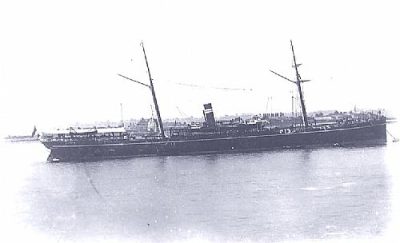
SS Bulimba 1882
Townsville 1880s
On 11 January 1883, Fred set sail for Queensland aboard the SS Bulimba. The ship, built in Glasgow and launched only a few months earlier in September 1882, was almost brand new when he began his long journey from London to Brisbane. Fred arrived in Cooktown on 5 March 1883. Records show he travelled as a farm labourer and was initially assigned to land at Bowen, intending to follow in his father’s agricultural footsteps.
However, like many young men arriving in Queensland at the time – and perhaps following the example of his uncle – the lure of gold soon proved irresistible, and he was drawn toward the mining districts of North Queensland. By 1884 he was in Townsville which was emerging as the commercial heart of North Queensland, driven by the expansion of the goldfields inland and the development of the Great Northern Railway. The town was booming – new buildings, businesses, and suburbs were appearing, and opportunity was everywhere for those willing to work.
Fred found his place in this world and began working in the goldfields, building a life in the harsh but hopeful environment of northern Queensland. On 9th September 1898, he married Esther Mulligan. Esther had been born in Multyfarnham, Ireland, in 1874 and emigrated to Australia as a young child, arriving in Townsville from Belfast in November 1875 at just two years old. Like Fred, her life had already spanned continents.
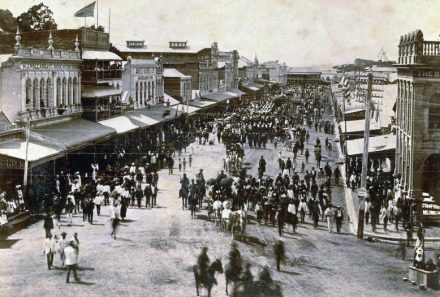
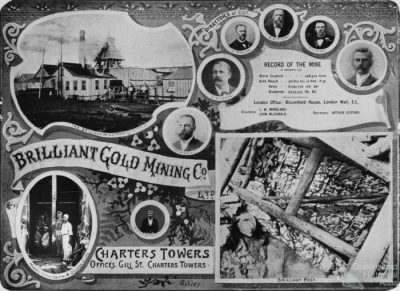
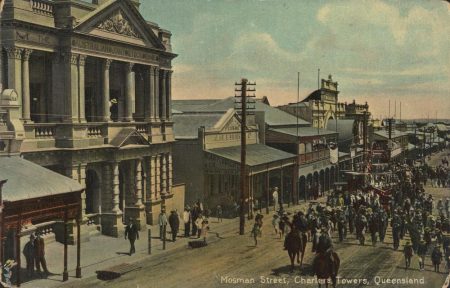
After their marriage, Fred and Esther moved to Charters Towers, one of the richest gold mining centres in Australia. Founded in 1871 after the discovery of gold, the town had grown rapidly into a bustling hub of industry and ambition, even boasting its own stock exchange. Over the decades, the surrounding fields produced vast quantities of gold, attracting miners from across the world.
Mining advert for Charters Towers
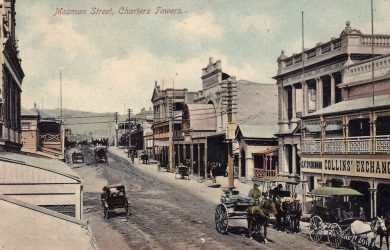
Mosman Street, Charters Towers
Fred and Esther made their home there and raised a family. Their first child, Violet May Mulligan, was born on 23rd May 1898, shortly before their marriage, and was later known as Violet Watkins. She was followed by Godfrey Charles Watkins, born 30th March 1900, and William Leonard Watkins, born 22nd March 1902.
During their years in Charters Towers, the family lived on Felix Street, a residential area during the later years of the gold boom. For a time, they were neighbours of Fred’s brother, Herbert Watkins, who had also emigrated to Queensland. The two brothers, who had once worked side by side on a farm in Wales, now found themselves living parallel lives on the goldfields of Australia.
Fred spent around 25 years working in mining, but by 1915, as the gold boom declined, the family returned to Townsville. They settled in South Townsville on Perkins Street, an area that was continuing to develop as both a residential and commercial district. Fred died in November 1919 at the age of 55, after a lifetime shaped by hard work and migration. He was buried in Belgian Gardens Cemetery in Townsville.
After his death, Esther made another significant move, relocating with her family to Newtown in Sydney, over a thousand miles away. Tragedy struck the family again when their son William died on 11th February 1923. He was buried at Rookwood General Cemetery, where Esther herself would later be laid to rest after her death on 19th December 1930, aged 54.
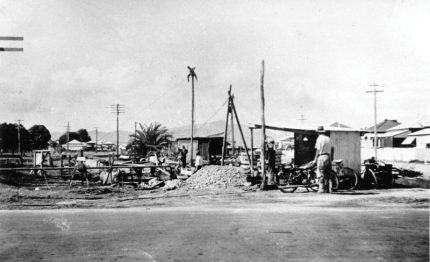
Perkins Street, South Townsville
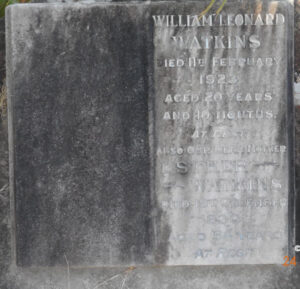
Grave of Esther and William Watkins
Their children carried the Watkins name into the next generation. Violet married grocer Charles Holt in 1928 and lived in West Kogarah until her early death in 1938 at the age of 40; they had one daughter, Gwen. Their son Godfrey married Alice Dorothy Bill in 1940, and together they had three children, including Neville and Michael. Godfrey died in 1968 in Ryde, Sydney, and Alice followed in 1989.
From a farm in Monmouthshire to the goldfields of Queensland and the suburbs of Sydney, Fred Watkins’ life tells a familiar story of migration, opportunity, and resilience – one that would shape generations to come.
Herbert Watkins
Herbert Stephen Watkins was born in 1861 at Pye Corner Farm, where he spent his early years working the land alongside his father and elder brother. Farming shaped his youth, and by adulthood he had taken on responsibilities of his own. He later moved to Cwm Farm in Christchurch and, by 1891, was recorded living there alone with two workers under his direction. The farm lay off what is now Royal Oak Hill, though nothing of it remains today – its fields long since cut through by the M4 motorway and buildings replaced by the Coldra Mill housing development.
By this time, Herbert had achieved a measure of success. His position at Cwm Farm suggests he was not only capable, but financially secure. The deaths of his parents in the years around this period may also have marked a turning point in his life. With both experience and some resources behind him, he made the decision in the 1890s to leave Wales and seek new opportunities abroad, joining his brother Fred in Australia.
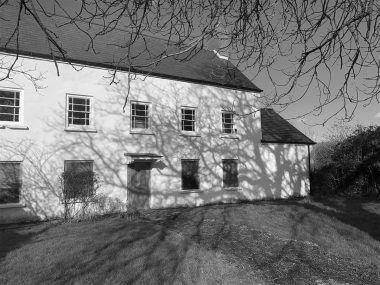
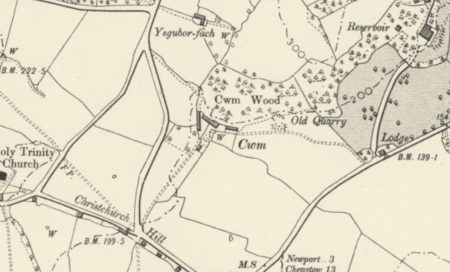
Cwm Farm, Christchurch
Charters Towers Stock Exchange 1900
He settled in Charters Towers, a booming goldfield town where fortunes could be made – or lost – overnight. There, he worked as a miner and lived near his brother Fred, becoming part of a tight-knit but precarious community built on speculation and hard labour.
Herbert’s involvement in the mining world soon extended beyond the day-to-day work of the goldfields. In June 1899, he appears in the records as chairman of a confirmatory meeting of shareholders for the winding-up of the No. 1 Florence Gold-mining Company, Limited. It was a formal role, suggesting he was more than just a labourer – likely a shareholder, and a man trusted by others involved in the venture. But the very nature of the meeting tells its own story: another mining company brought to an end.
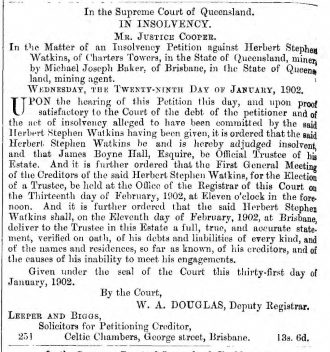
The risks of that world soon caught up with him. Just a few years later, in 1902, Herbert was declared insolvent by the Supreme Court of Queensland. The court described him simply as a miner of Charters Towers, unable to meet his debts. It was a fate shared by many on the goldfields, where speculation and uncertainty often led to financial ruin as quickly as success. Yet Herbert did not leave Queensland. Instead, he began again.
Around the time of his marriage, Herbert was living at the Bluff Road Hotel in the Millchester area of Charters Towers. The hotel stood at the heart of one of the busiest parts of the goldfield, surrounded by crushing plants and mining businesses. Like many of the more than sixty hotels operating in the district at the time, it served as a vital social hub – offering meals, lodging, and a place for miners and their families to gather. It was here, in this lively and transient setting, that Herbert was living as he rebuilt his life.
Herbert Watkins insolvent 1902
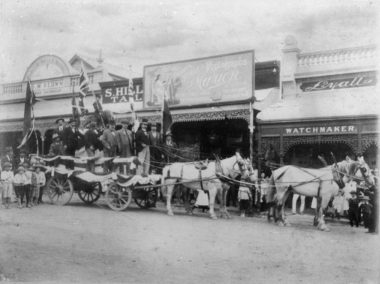
Celebrations in Charters Towers 1905
On 23rd September 1905, he married Adela Bertha Cameron, a Queensland-born woman, and together they began to establish a more settled home. By 1908, the couple were living on Philipson Road in Charters Towers, where Herbert was again working as a miner. They remained there at least until 1915, even as the gold boom that had drawn so many to the town was beginning to fade. The years that followed were marked not by speculation, but by steady work and gradual movement across the developing interior of the state.
By 1917, electoral records place Herbert and Adela in Cloncurry, a remote settlement known locally as “The Curry.” Herbert was working as a labourer – perhaps a quieter, more stable life than the one he had known in Charters Towers. The town itself was growing, newly connected to the railway in 1914, opening up opportunities and linking it to the wider world. It would later gain national significance as the starting point of the Royal Flying Doctor Service in 1928.
Sometime before 1922, Herbert and Adela moved again, this time to Ayr near Home Hill. Here, in a region known for cattle and sugarcane, they found permanence. The land once again shaped Herbert’s life, echoing his early years in Wales, though under very different skies.
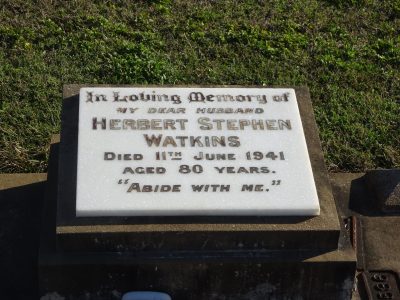
They remained there for the rest of their lives. Herbert died in June 1941 at the age of 80, and Adela in August 1955. Both are remembered at Home Hill Cemetery – a long way from Pye Corner Farm, but the final chapter in a life that had crossed continents, fortunes, and hardships.