St Brides is well known today for its ancient church of Saint Bridget, yet for nearly 140 years the Rehoboth Baptist Chapel also stood at the heart of village life. Construction of Rehoboth began in 1837 and took six years to complete. Built in a mixed architectural style with a gable-entry, the site on Church Road was far more than a place of worship. It encompassed a burial ground, the village school, and even the Church House Inn – together forming a lively hub for the community.
The name Rehoboth comes from Genesis 26, where Isaac, after disputes over several wells, finally dug one that was uncontested. He named it Rehoboth, meaning “room,” saying, “Now the Lord has made room for us, and we shall be fruitful in the land.” The chapel’s rise mirrored the rapid growth of the Baptist movement in Wales. In 1800 only around 60 Baptist chapels existed; by 1851 the number had climbed to 533, and by the century’s end there were 835 congregations with some 165,000 members.
The Baptist cause in St Brides began in 1826, guided by the Castleton Baptist Church where ministers had preached since 1700. The first service in St Brides, led by Castleton’s Rev. Jones, was held at a church shared with the Calvinistic Methodists. The congregation started with just two members – Isaac Harries, later a minister, and Mrs Davies, the wife of a local farmer – and grew slowly. Following a disagreement with the Methodists, the Baptists began meeting at Grey House farm and later at Elm Cottage.
The congregation continued gathering in private homes while attending communion at monthly services in Castleton. Construction of a chapel for the members began in 1837 and the chapel opened in 1844 with 30 members formally transferred from Castleton. The first pastor, Ebenezer Phillip Williams, led the church until 1850. By 1848, membership had risen to 54, with baptisms held in the reen opposite the chapel until traffic made the crossing unsafe.
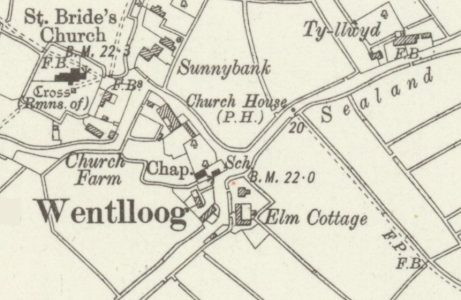
Map showing location of chapel and neighbouring school
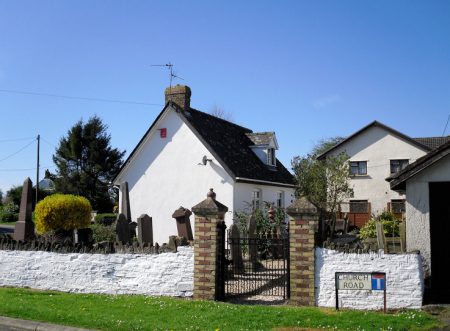
The former chapel 1990s | Gwent FHS
Rehoboth’s history was marked by alternating growth and decline. Pastors Richards (1854–1858) and John Morgan (1862–1871) strengthened the congregation, especially during the revival years, when a British School also opened nearby. However, long periods without a permanent minister followed. Pastor William Morgan (1892–1895) brought renewal but resigned after a dispute amongst the members about singing, and by 1908 membership had fallen to 42.
Despite fluctuating numbers, Rehoboth remained central to community life well into the 20th century. It hosted the Women’s Missionary Auxiliary, Young People’s Fellowship, Lady Baptists, and countless community events, from harvest festivals to hospital fundraisers. It was also the setting for many weddings, fondly remembered by generations – including Beryl and Trevor Watkins, who recalled their 1948 marriage at Rehoboth in a 1995 newspaper feature.
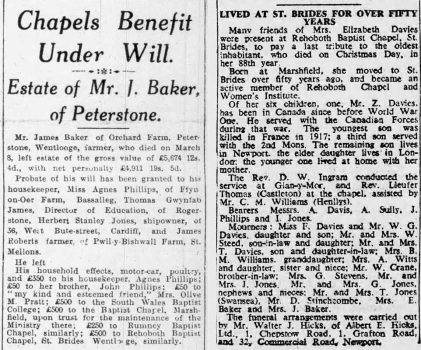
Local generosity also helped the chapel to flourish. In 1934, James Baker, a prosperous farmer from Orchard Farm, left £500 in his will – worth more than £30,000 today. His gift funded major improvements to the building, a gesture that showed the affection and loyalty Rehoboth inspired among its supporters.
The chapel was also the setting for many notable funerals, moments when the whole community came together in remembrance. In 1900, the funeral of John Phillips of Sutton Farm drew mourners from far and wide, a testament to his standing in the district. Almost half a century later, in 1949, villagers gathered again to honour Mrs. Elizabeth Davies, St Brides’ oldest resident at 88. She had lived in the village for fifty years and was remembered as a faithful member of both the chapel and the Women’s Institute.
Rehoboth Chapel in the press
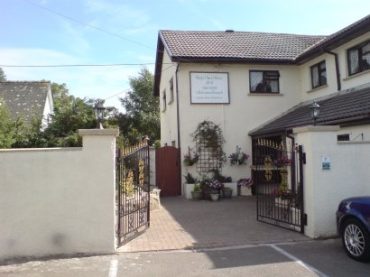
The Chapel Guest House
Rehoboth held its final service in 1979, shortly after the last recorded funeral in 1978 for Elizabeth Davies – a poignant close to the chapel’s long role at the heart of the community. A notice in the South Wales Argus two years later confirmed its closure and the cancellation of its wedding registration.
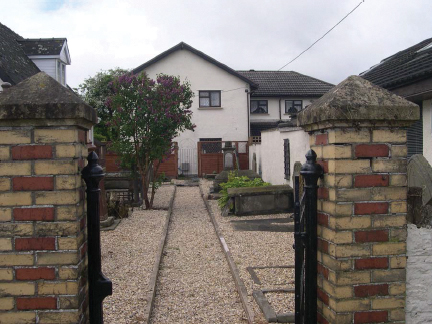
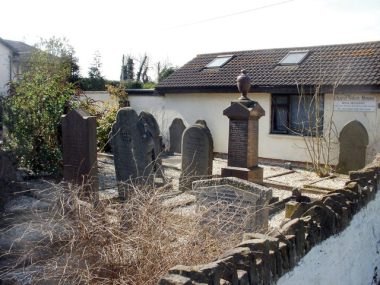
The graveyard, long neglected and overgrown, was later restored by Newport Council, who relaid the paths. Whether the closely spaced headstones were moved during this work is uncertain. Among those buried here are several notable families we have researched for this website: Philip and Mary Phillips of Greenmoor Farm and their son William Richards Phillips; Philip’s sister Jane and her husband David Evans, a Carmarthenshire Baptist preacher who led services at Rehoboth in the 1850s; and members of the Harris family of Walnut Tree Farm, including Kendrick Harris, remembered on the village war memorial.
After its closure, Rehoboth was refurbished and reopened in 1982 as the Chapel Guest House, a seven-bedroom B&B that operated successfully for many years before being sold in 2005. An attempt in 2018 to convert the property into a children’s care home was unsuccessful, and today the former chapel, along with the old schoolhouse (which closed in 1967), stands as a private residence.
With the Church House Inn closing in 2016 and later demolished, only the graveyard remains as a tangible reminder of Rehoboth’s past. Church Road itself has changed significantly, now lined with new residential developments, including large family homes.
Rehoboth graveyard 2010 | Jaggery
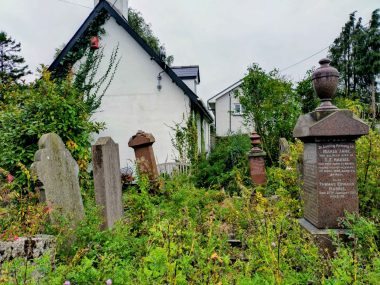
Overgrown Rehoboth graveyard, Sept 2025
When we visited in September 2025, the graveyard was once again overgrown, though we were pleased to learn that Wentlooge Community Council plan further clearance work. We hope this quiet corner of St Brides will once more become a place of interest, offering visitors the chance to reflect and to learn about the families who once worshipped here. Our thanks go especially to the Gwent Family History Society, who in the 1990s carefully mapped and transcribed the surviving memorials.
If you have stories, memories, or photographs of Rehoboth Baptist Chapel, we’d love to hear from you. Please email us at jon@welshfamilyhistory.com to help preserve and share its rich history.