T.R. Phillips Architect of Pontypridd

Blog: Thomas's Projects

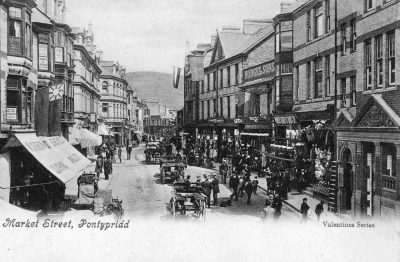
Market Street, Pontypridd 1920s
Office of T.R. Phillips, Market Street, Pontypridd 1920s

Thomas Richards Phillips (1858–1941) was our 2x great-uncle. Born at Greenmoor Farm in St Brides, he didn’t follow his father or siblings into farming. Instead, he trained as an architect. Having previously visited his childhood home and his final address in Cardiff, we were keen to explore his formative years in Pontypridd, where he relocated to live and establish his architectural practice.

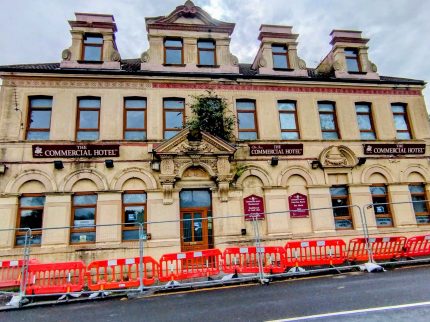
We began our tour of buildings designed by architect Thomas Phillips with a visit to the Commercial Hotel in Cilfynydd – a striking, statement building seen daily by thousands of drivers travelling on the A470. Cilfynydd, located just a mile from Pontypridd, was originally a small farming hamlet that rapidly expanded following the sinking of the Albion Colliery in 1884.

Commercial Hotel, Cilfynyd

When Thomas built the Commercial, it became the third licensed premises in the growing village. At the time, the hotel stood on the main road between Cardiff and Merthyr Tydfil, before the construction of the modern A470.

Although the pub has been closed for more than a decade – its licence was revoked in 2013 – it still retains many of its original architectural features. Despite visible wear, the building appears to be undergoing renovation, and we were able to stop and take a few photos of this once-grand structure. Our second stop took us to Hopkinstown, a small village west of Pontypridd and a former coalmining and industrial community

Commercial Hotel
Commercial Hotel, Cilfynyd 2025
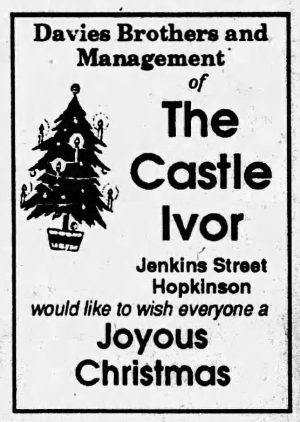
The Castle Ivor
Christmas at the Ivor

Castle Ivor, Hopkinstown

We arrived at number 14 Jenkins Street, in search of the Castle Ivor pub. It was a narrow residential road, and there was no sign of a pub when we arrived. Although the building is still listed as open on some online maps and directories, we believe it closed for good around 2013 and has since been demolished, with a private home now occupying the site – leaving no visible trace of what once stood there.

Information about the pub is quite scarce. We found only a few newspaper adverts, mentions of a local darts team, and brief records of past licensees. We believe that Thomas’s version of the hotel was built on the site of the earlier Castell Ivor Public House, and in the early 20th century it served as a venue for local property auctions and coroners’ inquests. After a quick photograph of the location, we continued our journey toward Ferndale, taking the scenic route through the hillside hamlet of Llanwonno.

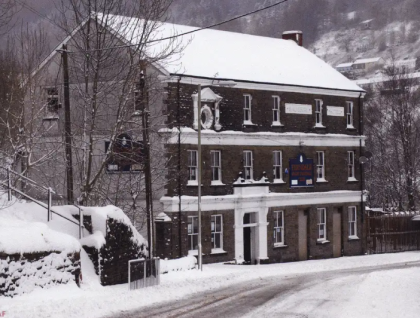
Salisbury Hotel, Ferndale

After visiting Llanwonno, we made our way down the steep valley roads to Ferndale, heading for the former site of the Salisbury Hotel on Station Road – another of Thomas’s valley pubs built at a cost of £4,000. Disappointingly, the original building has been redeveloped by Ferndale Rugby Club into a modern, fairly non-descript structure. Though the new building offers little architectural interest, it does at have a small car park which gave us a chance to stop and take a photo!

We later found a Facebook page where people still share fond memories of great nights at the Salisbury, once described as “the best pub in Ferndale.” Clearly, it was much loved. Looking at a photo from 2010, the original building appeared solid and imposing, with an interesting circular window on the top floor and Thomas’s signature mouldings framing the façade.

Salisbury Hotel, Ferndale
Salisbury Hotel, Ferndale 2010
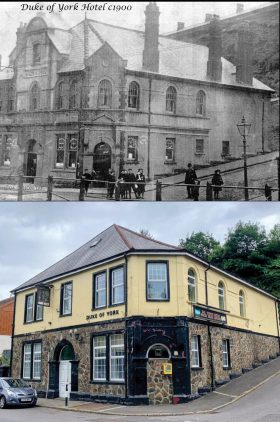
Duke of York Tylorstown
Duke of York, Tylorstown

Duke of York, Tylorstown

Next on our tour was the former Duke of York Hotel and Pub on East Road in Tylorstown. It was designed by Thomas Phillips and completed in 1899 with the license granted in November of that year. The original building included a stable block and was a substantial and eye-catching structure featuring a striking roofline and ornate detailing. It served generations of locals and remained a much-loved community pub until as recently as 2020.

Sadly, it never reopened following the COVID pandemic, and when we visited, it was being used as a private home. Comparing archival photos with the current building, it’s easy to see how much has changed – many of the original architectural features have been lost. We stopped briefly on the busy main road to capture a quick photograph.

Terraced Housing, Stanleytown 

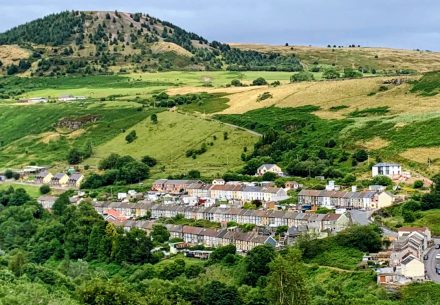
From there, we continued along the main road to find a good vantage point to view one of Thomas’s most notable achievements: a terraced housing development in Stanleytown. Built in 1895 to accommodate colliery workers, the project comprised eighty linear homes commissioned by the Stanley Building Club and designed by one T.R. Phillips of Pontypridd. The plans, schedule and contract were available to view from Thomas’s office in Pontypridd, with tenders to be received by 12th February 1894. Set on the eastern side of the valley, the development consists of three rows: Upper, Middle, and Lower Terraces.

Although the houses no longer serve miners, they remain popular with families. Remarkably, the view of the terraces has changed very little over time and continues to attract photographers and heritage enthusiasts. We parked just off Penrhys Road in Tylorstown to take our own photo of this iconic scene.

Stanleytown, terraces
The Stanley, Stanleytown
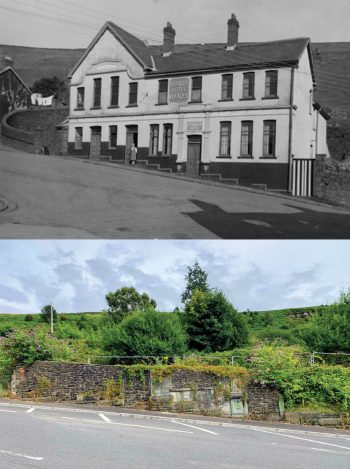
The Stanley - Then & Now

Stanley Hotel, Stanleytown

Staying in Stanleytown, we completed our tour with a visit to the former site of the Stanley Hotel on Upper Terrace. Another of Thomas Phillips ventures built at a cost of £2,030. Thomas appeared at the licensing hearing to support the application and pointed out the hotel was needed to serve the growing mining community. He was recalled to explain his business connections, as he was also the Secretary of the Newbridge Rhondda Brewary. This hotel served the local community for many decades, until it was tragically destroyed by fire in 1975. The building was eventually demolished, and today the site stands as open wasteland.

Yet a small section still remains. If you look closely, you can spot the base of the left-hand column that once framed the hotel’s entrance. While modest, the remaining structure reveals subtle design features, such as mouldings and column detailing, that are unmistakably Thomas’s work. We parked on the steep hill beside the former site to take in what little remains.

With that, we headed home, reflecting on a fascinating day spent tracing Thomas’s architectural legacy across the valleys. After 130 years, to have three of the six projects still standing seems a reasonable score! We are currently compiling a list of other projects he worked on and hope to visit and document more of them soon.

Jon & Ann-Marie Curtis July 2025.

If you have anything to add to the blog, or further information about Thomas, please get in touch. Contact: research@skinnerfamilyhistory.com

Jon and Ann-Marie
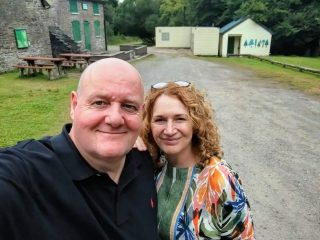
Jon & Ann-Marie in Llanwonno