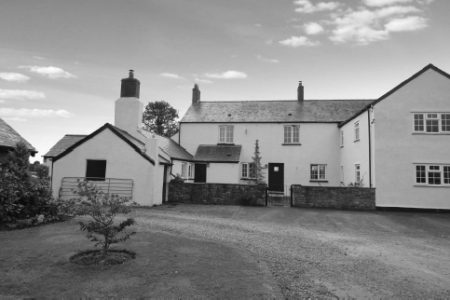
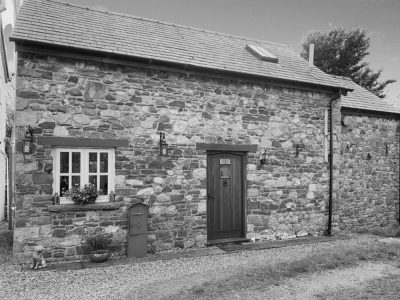
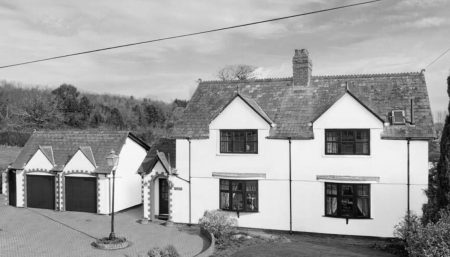
Tyn-y-Brwyn, also known as Tynybrwyn, was once a thriving 19th century dairy farm. Spanning almost 400 acres is was set within the tranquil countryside of Coedkernew, near Newport. Whilst much of the land is still used for farming, the buildings have been sensitively adapted for residential use, making the most of its attractive rural position and far-reaching views.
The former farmhouse is now a comfortable family home overlooking open farmland, with approximately three acres of fenced paddocks extending beyond the rear garden. The original farm barns have been converted into two residential dwellings, while nearby, on former farmland, stand the Tyn-y-Brwyn Cottages – a substantial family home developed during the 1980s.
Rees and Winnie Phillips Move in
Our research into Tyn-y-Brwyn began while investigating the Phillips family of Greenmoor Farm, St Brides. Following the death of his mother in 1899, Rees Phillips moved from Greenmoor to take up the tenancy at Tyn-y-Brwyn Farm. Shortly afterwards, he married Winifred “Winnie” Brind of Newport, and the couple settled in Coedkernew.
Their wedding took place at Coedkernew Parish Church on 9 October 1900. Prior to her marriage, Winnie had lived with her family on London Road, Maindee. She was the daughter of Edwin Brind, a haulier, and his wife Alice. Rees and Winnie made their home at Tyn-y-Brwyn, where they raised three children: Mary Jane (born 1907), Hilda Kesia (1909), and Brind Richards (1912).
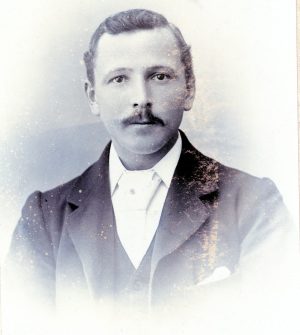
Rees Richards Phillips
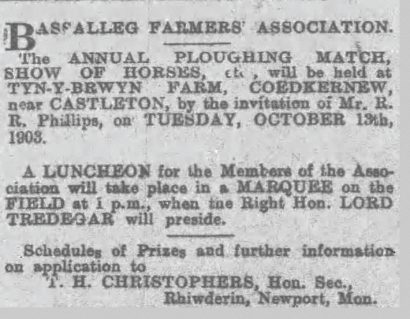
Bassaleg Farmers' Associaton Show 1903
Rees quickly established himself as an influential figure within the local farming community. In 1903, Tyn-y-Brwyn hosted the annual exhibition of the Bassaleg Farmers’ Association. Alongside traditional ploughing competitions, prizes were awarded for hedging and ditching, root crops, horses, rickyards, and dairy produce. Lord Tredegar served as president of the association, with Rees acting as vice-chairman of the committee and his brother John also serving as a member. Despite wretched weather, the event was widely regarded as a great success.
During his time at Tyn-y-Brwyn, Rees built an excellent reputation for the quality of his horses and was a regular competitor at agricultural shows. At the Cardiff Horse Show in 1912, he competed against exhibitors ranging from Viscount Tredegar to his own brother, Phillip. In the two-year-old hunter class, Rees was awarded a rosette with a horse aptly named Pancake. The farm also became a hub for local hunting activities, a role it continued to play until 1924.
Tragedy struck the farm in 1931 when two men, including one of Rees’s farm labourers, were killed after being struck by a coach on Coedkernew Hill following an evening at a carnival. Rees had been part of the same outing and later appeared at the inquest to give evidence regarding his employee. The driver was later exonerated from blame.
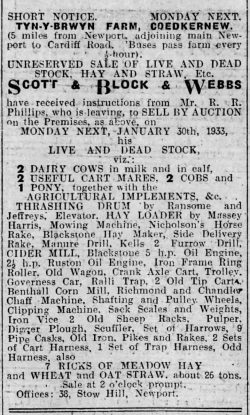
By the early 1930s, both Rees and his elder brother Phillip of Greenmoor Farm were approaching retirement, prompting the need for succession planning. Rees, Winnie, and their children Mary and Brind returned to Greenmoor to live with Phillip. As a result a short notice sale was held ay Tyn-y-Brwyn in 1933, with cows, horses, and farming equipment auctioned. Just two years later, in 1935, Phillip passed away, and Rees’s son Brind Phillips became the fourth generation of the Phillips family to run Greenmoor Farm.
Tyn-y-Brwyn Farm sale 1933
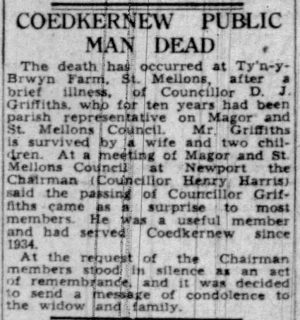
Death of D. J. Griffiths 1944
A Local Councillor Takes Over
Rees was succeeded at Tyn-y-Brwyn by dairy farmer David John Griffiths and his wife Elizabeth. They were recorded at the farm in the 1939 Register, living there with their two children and four employees. David enjoyed success at agricultural shows, winning first prize with a Shorthorn bull at the Bedwellty Show in 1936 and again achieving success at the St Mellons Show the following year.
Sadly, David’s time at the farm was cut short by his death in 1944 following a brief illness. He was just 44 years old and had served as a councillor on the Magor and St Melons Council for ten years. His colleagues stood for a minutes silence to mark his passing.
Point-to-point returns to Tyn-y-Brwyn
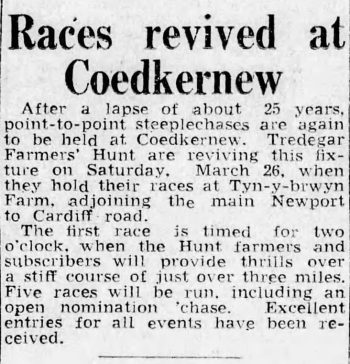
Following David Griffiths’s death, William (Bill) J. Jones and his wife Beatie took over the farm, remaining there for almost four decades. Bill was a well-known point-to-point and National Hunt rider who went on to ride more than 100 winners. He rode his first winner, Mary Jane, at the Tredegar Farmers in 1949 and his last on Miss Ella at Pentyrch in 1973. Under his stewardship Tyn-y-Brwyn returned to prominence in 1949 when, after a 25-year gap, it hosted the Tredegar Farmers’ Association Point-to-Point Steeplechases. This major event featured catering and on-course betting and attracted large crowds.
Hunting continued to be closely associated with the farm, with advertisements appearing regularly until as late as 1976.Both Mr and Mrs Jones were active participants in agricultural and rural life. In 1954, Beatie Jones exhibited at the Tredegar Farmers’ Hunt Puppy Show, while throughout the 1950s and 1960s Bill Jones competed at agricultural shows and regularly sold Friesian cattle at Newport Cattle Market.
Point-to-point at Tyn-y-Brwyn Farm
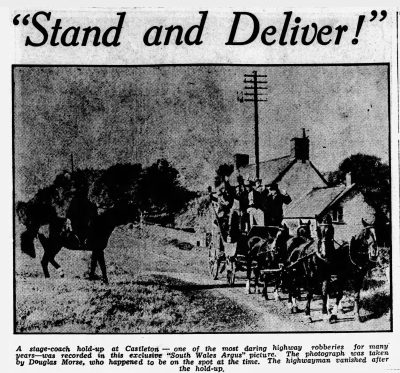
Stand and deliver at Coedkernew 1955
As a skilled rider, Bill took on the role of a highwayman during a historical re-enactment in 1955. A coach travelling to London was theatrically “held up” in Castleton as part of a recreation of an historic coaching journey. The event caused some confusion due to the realistic nature of the reporting in the local paper. It included a line that the police were seeking Bill for questioning as his whereabouts during the robbery were unknown! Bill’s riding career ended in 1974 after a fall from the roof of a barn he was repairing.
Bill Jones died in 1981 at the age of 62 following a motoring accident, having spent 37 years at Tyn-y-Brwyn. His funeral at St Mary’s Church, Marshfield, was well attended, with representatives from both the farming families of Monmouthshire and the riding community present, reflecting the esteem in which he was held. The Bill Jones Memorial Trophy for riders in South Wales was established in his honour. The farming business he founded continued under the management of his sons, and in 1986 W. J. Jones and Sons were awarded Best Field of Maize at the St Mellons Show.
Changes at the Farm
The past 45 years have seen significant change at Tyn-y-Brwyn. In 1980, permission was sought to convert the farm barns into two high-quality residential units, although this may not have progressed at the time. Further applications were made by W. J. Jones and Sons in 2000 and again in 2003, when consent was finally granted. The converted barns were subsequently marketed in 2005.
In 1995, the detached four-bedroom farmhouse –without land – was advertised to let to professionals at £500 per calendar month. Thirty-eight acres of land were sold in 2007, followed by an application to develop a solar farm in 2015.
Barn conversion at Tyn-y-Brwyn Farm
Tyn-y-Brwyn Cottages on former farm land
Tyn-y-Brwyn Today
In 2025, the former farmhouse was offered for sale as a superbly refurbished three-bedroom semi-detached home, occupying a stunning position overlooking open farmland. The asking price was £550,000. Accessed via a quiet lane from the A48 it remains a peaceful location despite nearby commercial developments.