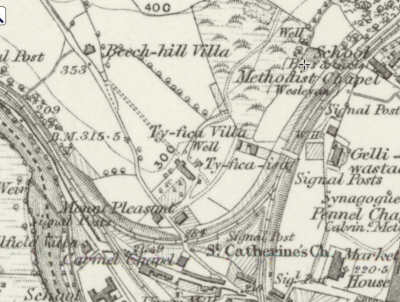
An early OS map of Pontypridd showing Tyfica Villa
Thomas Richards Phillips (1858–1941) was our 2x great-uncle. Born at Greenmoor Farm in St Brides, he didn’t follow his father or siblings into farming. Instead, he trained as an architect. Having previously visited his childhood home and his final address in Cardiff, we were keen to explore his formative years in Pontypridd, where he relocated to live and establish his architectural practice.
We set out to discover what remains of the places where he lived, worked, and built his life – and what still stands of the numerous projects he was involved in. On a sunny Saturday in July, armed with a list of locations and a few old maps, we headed up the A470 to retrace his steps. In Part One, we focus on the places where Thomas lived, worked, and married. In Part Two, we’ll explore some of the buildings he designed.
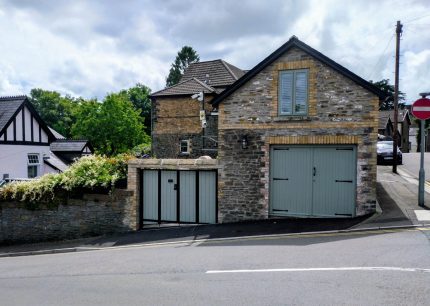
Tyfica Villa, Tyfica Road, Pontypridd
According to the 1891 census, Thomas – then a single man – was living at a property called Tyfica Villa. Using an 1850 Ordnance Survey map and a side-by-side georeferenced map viewer, we identified it as one of only two buildings in the area at the time, likely located at the junction of what would later become Tyfica Road and Thomas Street.
Most of the properties in this part of Pontypridd were built between 1840 and 1890, and by the time Thomas arrived in 1885, the street had expanded considerably. By then, properties were no longer listed by name on maps, making it harder to identify specific buildings. Nevertheless, the street still features some beautiful period homes, and we were able to photograph the junction where we believe Thomas once lived. His home would have been less than a ten-minute walk from his office on Market Street.
Tyfica Road, Pontypridd
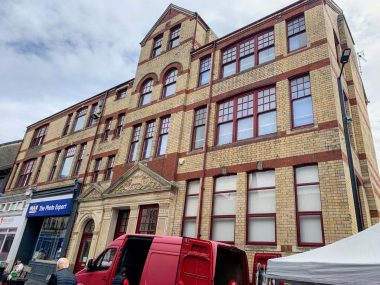
Old Bank Chambers, Market Street, Pontypridd
Old Bank Chambers, Market Street, Pontypridd
Next on our tour was Pontypridd town centre. Thomas chose the Old Bank Chambers on Market Street as the base for his architectural practice – an address he maintained for nearly 50 years. Trading under the name T.R. Phillips, he advertised frequently in the local press, with notices inviting builders to visit the Chambers to consult plans for upcoming projects. These snippets offer a fascinating glimpse into the working life of a busy, independent architect in the South Wales Valleys.
The Old Bank Chambers is a historic building that – as the name suggests – was originally a bank. When we visited the bustling Market Street, the Chambers were in good condition, with some renovation work underway. The original stone façade around the doorway remains. beautifully intact. Even better, we discovered a bar directly opposite – so we sat outside with a drink and took in the view, imagining the bustle of clients and builders coming and going over a century ago.
Darwonno Farm, Llanwonno
After leaving Pontypridd, we headed up some very steep mountain lanes to reach Llanwonno – a place Thomas would have spent considerable time after getting engaged to a local women. While living in Pontypridd, he met Annie Llewellyn, who lived with her family at the historic Darwonno Farm, which was located deep in the forest of this hilltop hamlet.
The former farm lies high on the eastern slopes of Cefn Gwyngul, between the historic mining valleys of the Rhondda and the Cynon. It’s a beautifully remote place. Today, Llanwonno consists mainly of St Gwynno’s Church, the Brynffynon Hotel, and surrounding forestry. We began our visit with a drink in the busy pub – a lovely spot full of character, friendly staff, views across to the church, and some charming old photographs on the walls.
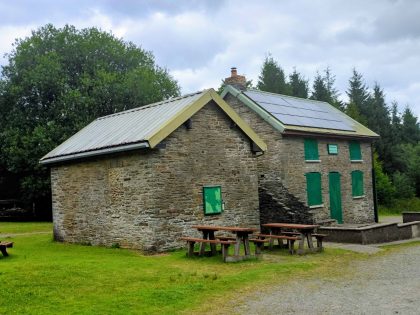
The former Darwonno Farm, Llanwonno
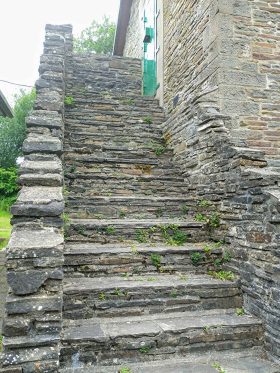
Original farm steps, Darwonno Farm, Llanwonno
Annie was the daughter of David Llewellyn, JP, a gentleman farmer who lived at Darwonno for around 50 years. The hilltop farm had 11th century origins and remained active until around 1950, when it was abandoned and many of the buildings lost. The last inhabitant we could find was a young shepherdess who lived there in the late 1950s, when the buildings were still without electricity. Fortunately, two former buildings survived and were later restored as part of what is now the Daerwynno Outdoor Centre – run locally and used by school groups for outdoor learning.
We parked near the Forestry Commission gates and walked about 500 metres to the site. Although the centre was closed, we explored the grounds and took some photographs. The original stone staircase, still standing, was particularly impressive. Sitting on the benches in the quiet clearing, it was hard to imagine this had once been a bustling hilltop farmstead.
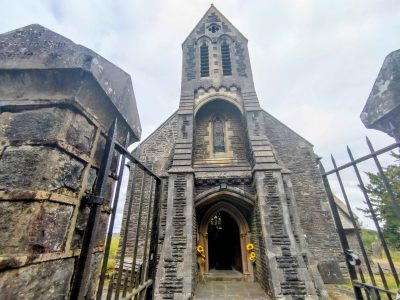
St Gwynno’s Church, Llanwonno
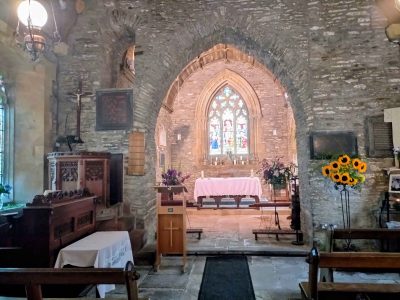
On 22nd October 1891, Thomas married Annie at St Gwynno’s Church. His younger brother Rees travelled to Llanwonno to act as a witness. When we visited, we were incredibly fortunate to find the church open for a flower festival, which gave us the opportunity to explore both the interior and the steeply sloping graveyard. The volunteers were doing a fine job passing on local history, and had even erected a temporary memorial to local darts legend, Leighton Rees!
St Gwynno’s is a medieval church on an ancient site, with two early stone crosses built into the south wall. Inside, we found two plaques commemorating members of the Llewellyn family. Just outside is the grave of Guto Nyth Brân, the legendary Welsh runner. Born Griffith Morgan, he was said to be so fast he could catch birds in flight.
Saint Gwynno Church, Llanwonno
Saint Gwynno Church, Llanwonno
Shortly after their wedding, Thomas and Annie moved to Whitchurch, Cardiff, where they bought Ty-Clyd Farm. This marked the end of Thomas’s time living in Pontypridd – although he would continue to work in the town for many more decades.
In Part Two, we head deeper into the valleys to explore Ferndale, Tylorstown, Stanleytown, and more – all towns where Thomas designed hotels for their growing communities. Over a century later, we were curious to see what, if anything, still stands.