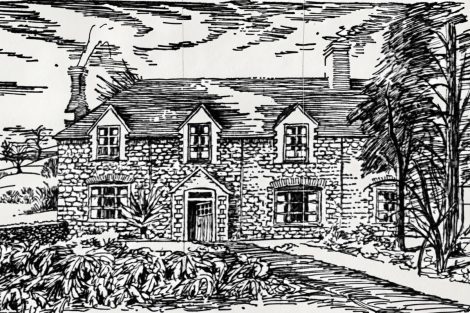
William Baker (1798-1885), our 3rd great-grandfather, belonged to the first generation of our Baker family to be born in Monmouthshire. His parents had moved from Bristol to Manor Farm in St Brides Netherwent, a tiny and deeply rural parish in the rolling countryside of south-eastern Monmouthshire, approximately eight miles east of Newport and two miles north of Magor.
William was born on 20 December 1798, the son of Samuel Baker of Bristol and Catherine Levi Phillips of Haverfordwest. According to family history, Samuel and Catherine stopped at the Rock and Fountain coaching inn in Penhow and, almost by chance, decided to purchase nearby Manor Farm. This unlikely beginning established the family in Monmouthshire and eventually helped the Bakers become the county’s second-largest farming family by landholding during the nineteenth century.
William was one of eleven children born to Samuel and Catherine. His siblings were Eliza Baker (1792-1880), Mary Grace Baker (1792-1883), Samuel Baker (1796-1856), Robert Baker (1797-1854), Catherine Baker (1799-1808), Nancy Baker (1802-1874), George Baker (1804-1878), John Baker (1806-1878), Matilda Baker (1806-1866) and Catherine Jane Baker (1808-1866).
Several of William’s siblings had fascinating lives of their own. Samuel extended the family’s association with Goldcliff, where he lived and farmed at Hinton House, a notable agricultural residence. Nancy married William Jones, who became the vicar of Undy, and together they raised a large family at the vicarage. George became a successful fishmonger and traded from 154 Commercial Street in Newport, while Catherine Jane married Isaac Lawrance and raised a family at the substantial Llandevaud Farm.
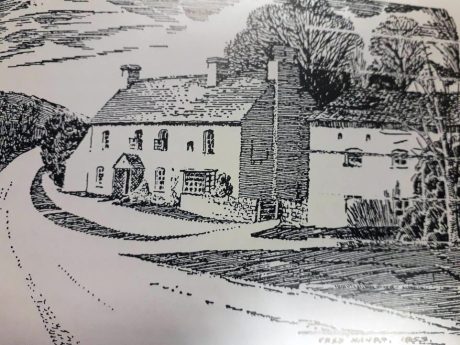
The Rock & Fountain Penhow
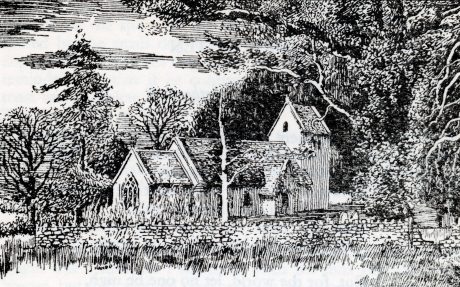
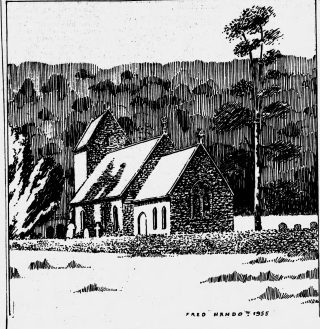
St Bridget's Church in Netherwent by Fred Hando
William grew up at Manor Farm, where he received an education before learning the practical work of farming alongside his father and brothers. He was only fourteen years old when his father, Samuel, died in 1813. In 1826, at the age of twenty-seven, William married Ann Leonard (1800-1884) of Magor at St Bridget’s Church in St Brides Netherwent.
William and Ann began married life at Manor Farm with the wider Baker family. Their first two children were born there: Samuel Baker (1826-1906) and Ann Baker (1827-1896), our second great-grandmother. In 1829, William and Ann moved to Goldcliff, a coastal parish approximately six miles south-east of the growing industrial port of Newport. They settled at Great Newra Farm on Chapel Lane. During the nineteenth century, the property underwent a significant transformation from a historic seventeenth-century estate into a modernised Victorian working farm.
At the time of their arrival, Goldcliff was a remote, close-knit and deeply religious farming community. The parish was shaped by its position on the low-lying Caldicot Levels, where agriculture, drainage and the nearby Severn Estuary determined much of everyday life.
William and Ann had nine more children while living at Goldcliff: Selina Baker (1829-1903), Catherine Baker (1829-1873), Matilda Baker (1829-1913), William Leonard Baker (1831-1893), Ellen Baker (1836-1913), Thomas Leonard Baker (1837-1902), Stephen Leonard Baker (1839-1928), George Baker (1842-1921) and Albert Sidney Baker (1843-1921). Together with Samuel and Ann, this gave the couple eleven children.
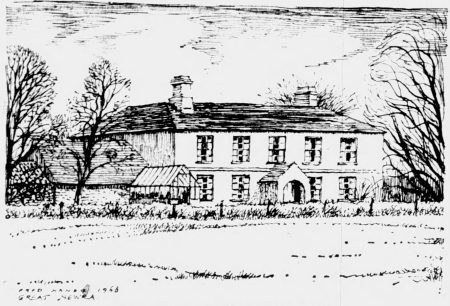
Great Newra Farm by Fred Hando
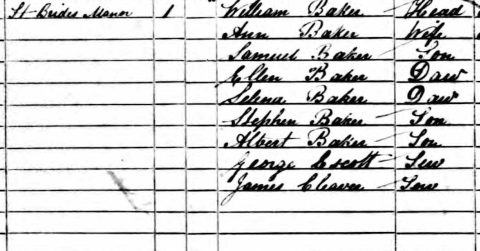
Manor Farm 1861 Census
Although William lived at Goldcliff, tithe records show that he also occupied land in St Brides Netherwent owned by his mother. This included Clyfish Farm and demonstrates that William maintained close agricultural and family connections with his home parish throughout this period. After achieving considerable success at Great Newra Farm, William and Ann returned to St Brides Netherwent during the 1850s and took over the Baker family home at Manor Farm.
The 1861 census records sixty-two-year-old William as the head of a 414-acre farm employing seven men. Five of the couple’s children were also living at the property. By the time of the 1871 census, three of William and Ann’s children remained at Manor Farm. William was then responsible for approximately 300 acres and employed four men. His status as a substantial farmer and occupier entitled him to vote, and his name appeared regularly in the electoral registers during these years.
William’s final census appearance was in 1881, when he was eighty-two years old and the scale of the farming operation had been considerably reduced. His wife Ann remained with him at Manor Farm, along with their daughter Selina, a granddaughter and one servant. Ann died at Manor Farm on 7 November 1884, in her eighty-fourth year. William survived her by only six months and died on 5 May 1885, aged eighty-six. They were buried together at St Bridget’s Church in St Brides Netherwent, the same church in which they had married nearly sixty years earlier.
The legacy of William and Ann was carried forward through their large family. Their eldest son, Samuel, remained in the area and established his own successful farming enterprise at Lower Millbrook Farm in Llanvaches. Their daughter Ann, our 2nd great-grandmother, married William Watkins, and the couple farmed successfully at Pye Corner Farm in Nash.
The final resting place of William and Ann
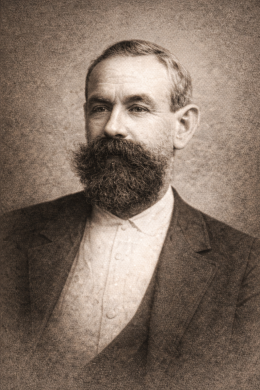
William L. Baker
Selina remained at Manor Farm for many years before marrying in her fifties and moving to Green Street Farm in Redwick. Catherine had a comparatively short life and was living at the impressive Redwick House when she died at the age of forty-three. Matilda married a successful butcher and spent the remainder of her life in Newport. William Leonard Baker had perhaps the most extraordinary life of all William and Ann’s children. He emigrated to Australia, achieved success during the gold rush and later became a member of parliament. His remarkable journey took the Baker name far beyond Monmouthshire.
Ellen married into the Gale farming family and lived at Innage Farm in Mathern. Thomas moved to Redwick, where he prospered at Longlands, a substantial property that remained in the Baker family for many years. Stephen farmed at several properties, including Penylan Farm in St Brides Netherwent, before retiring to Rose Cottage in Magor.
George raised his family at Lower House Farm in Llanvair Discoed. The youngest son, Albert Sidney Baker, remained at Manor Farm and eventually succeeded his father there, continuing the family’s connection with the property into another generation.
Through their work at Great Newra Farm and Manor Farm, William and Ann Baker helped consolidate the family’s position among the leading agricultural families of nineteenth-century Monmouthshire. Their eleven children carried that legacy across the county and, in William Leonard Baker’s case, as far as Australia. William’s life therefore forms an important chapter in the history of the Baker family and its long association with the farms and communities of south-eastern Monmouthshire.
Something to add? Email: jon@welshfamilyhistory.com