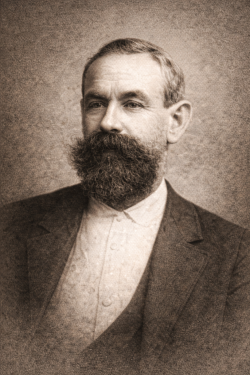
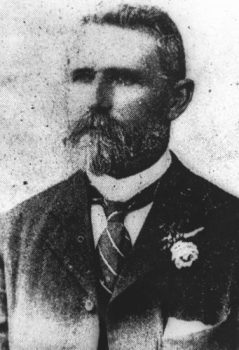
William Leonard Baker was born on 16 May 1831 at Goldcliff, Monmouthshire. He was the second son among eleven children of William and Ann Baker (née Leonard). The family were successful farmers, and like his brothers, William grew up working on the family farm.
At the age of 21, William is believed to have emigrated to Australia in 1852 during the height of the Victorian gold rush. Gold had been discovered in 1851 at Clunes and Ballarat, sparking a dramatic influx of migrants and transforming Victoria into one of the world’s richest gold-producing regions. Mining settlements such as Bendigo and Castlemaine quickly developed into thriving, if often chaotic, towns, with miners primarily working shallow alluvial deposits.
Chasing the Gold Rush
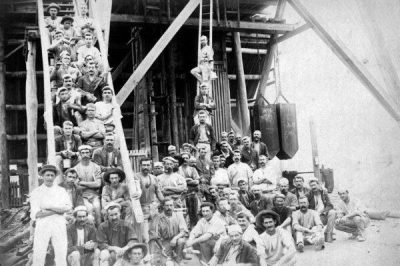
Like many prospectors of his generation, Baker followed new opportunities northward. He later moved to Queensland, where he found success in mining ventures at Cape River and Charters Towers. The Cape River rush began in 1867 and was one of North Queensland’s earliest significant goldfields. This was followed by the Charters Towers gold rush in 1871, after gold was discovered by Jupiter Mosman at Towers Hill. A government gazette entry dated 1 November 1874 records Baker as residing in Sydney, suggesting he was active across multiple colonies during this period.
Baker’s move to Australia appears to have influenced other members of his family. His sister, Ann Watkins (née Baker), remained in Monmouthshire, but her sons – Herbert and Fred Watkins – later followed a similar path to the Queensland goldfields. Fred emigrated first in 1883, with Herbert following in 1895. It is likely that Baker’s earlier experiences and success in Australia helped encourage or guide their decisions, reflecting a broader pattern of family migration during the 19th century.
Charters Towers Gold Rush
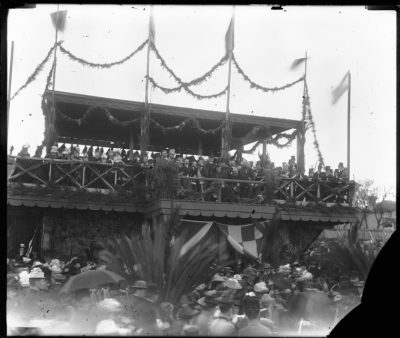
Proclamation of responsible government 1890
A Move to Wyndham
With the wealth he accumulated, Baker moved to the far north-west of Western Australia in 1885, he established a store at Wyndham and worked as a shopkeeper. He also retained property interests in Queensland, reflecting his earlier success there. Established in 1885–1886 as a crucial port, Wyndham, quickly boomed as a gateway for over 5,000 miners traveling to the Halls Creek goldfields. By 1886, it was a bustling town with multiple hotels, pubs, stores, and service industries.
In 1890, as Western Australia moved toward self-government under the Constitution Act 1889, Baker entered public life. He served as a Justice of the Peace and stood for election as an independent to the newly formed Legislative Assembly. He was elected on 20 December 1890 as the member for East Kimberley. This marked the beginning of responsible government in the colony and the establishment of a bicameral parliament.
A Place in History
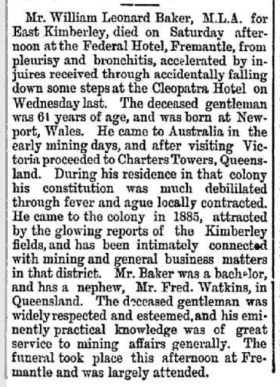
Baker’s parliamentary career, however, was short-lived. He died in office on 7 January 1893 at the Federal Hotel in Fremantle, Western Australia, aged 61. The cause of death was recorded as pleurisy and bronchitis, though contemporary reports indicate that his condition was exacerbated by injuries sustained in an accidental fall down steps at the nearby Cleopatra Hotel several days earlier.His health had already been significantly weakened by illness – described at the time as “fever and ague” – contracted during his years in the Queensland goldfields. Despite this, he remained active in business and public life until shortly before his death.
At the time he died, Baker was still serving as the member for East Kimberley while residing in Wyndham on the North West Coast. He holds the distinction of being the first member of the Western Australian Legislative Assembly to die in office. His funeral took place in Fremantle and was widely attended, reflecting the respect in which he was held by the community.
Death of William Baker
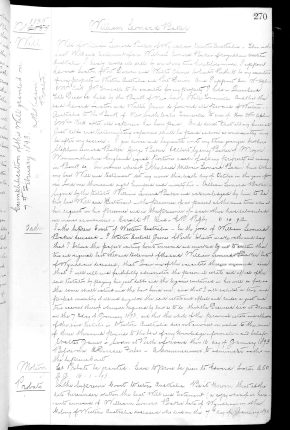
William Baker's Will
A Complex Estate
Baker left a will dated October 1892. It confirms that he was unmarried and had no children. His estate included property and funds in Western Australia, as well as assets held through the Bank of New South Wales in Townsville, Queensland. He left his estate in equal shares to his three younger brothers – Stephen Leonard Baker, George Baker, and Albert Sydney Baker – who were living in Monmouthshire, Wales. The administration of his estate proved somewhat complex, with probate in the United Kingdom not being finalised until 11 January 1898.
Following his death, legal notices published in Queensland confirm that Baker held significant assets there in addition to his Western Australian estate. In March 1893, the Supreme Court of Queensland issued notice that “ancillary probate” would be sought to administer his Queensland holdings. The executors named for this purpose were William Aplin and William Kirk, both of Townsville.
A Man of Influence
Executor William Aplin was a prominent North Queensland businessman and politician, closely associated with the development of Townsville and the surrounding mining districts. A successful merchant and pastoralist, he later served as a member of the Queensland Legislative Council. His role as executor of Baker’s Queensland estate suggests that Baker was well connected within influential commercial and political circles in the region.
Baker was described in the probate notice as a “gentleman,” reflecting his established financial standing at the time of his death and reinforcing the extent of his business and property interests across multiple Australian colonies.
William Aplin
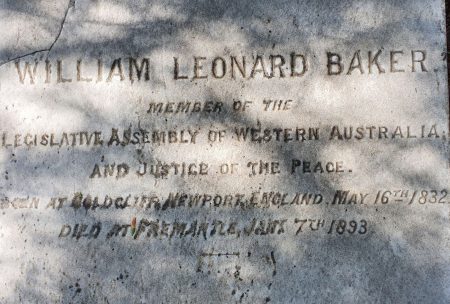
William's headstone in Freemantle
A Final Resting Place
William Leonard Baker was originally laid to rest at the Skinner Street Cemetery in Fremantle, the town’s principal burial ground from 1852 to 1899 and the final resting place of many early pioneers of Western Australia. Although the cemetery is no longer in use, its historical significance endures. Between 1930 and 1935, many headstones were relocated to Fremantle Cemetery on Carrington Street, where they now form part of a dedicated Pioneers Section. Today, a college stands on the original Skinner Street site, marking the passage of time.
William’s life reflects the journey of many 19th-century pioneers – spanning rural Wales, the goldfields of eastern Australia, and the developing frontier of Western Australia – yet his story remains distinctive through his role in the colony’s first parliament and his connections across family and enterprise. If you can add to the story of this remarkable man, please contact: jon@welshfamilyhistory.com.