The Watkins Family of Whitson and Pye Corner in Nash
A potted history
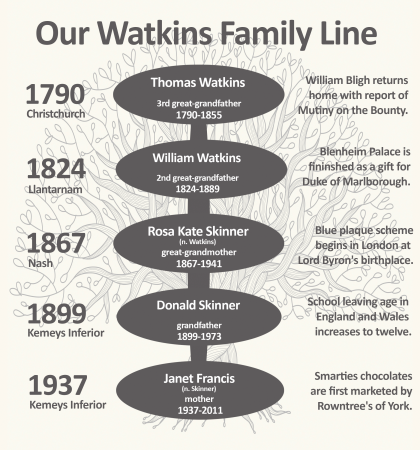
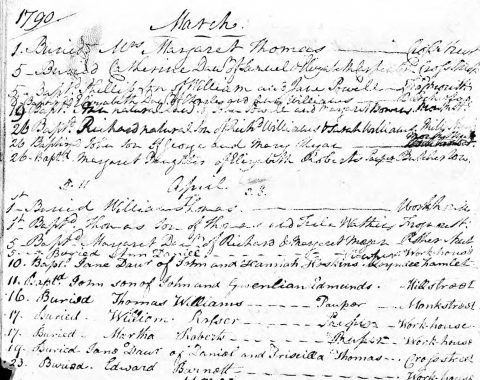
The Watkins family of Whitson are the maternal ancestors of our grandfather, Donald Skinner. Our research into this branch of the family began with the birth of Thomas Watkins in 1790, from which we uncovered a family closely connected to Whitson and Pye Corner in Nash. Thomas was the son of Thomas and Julia Watkins of Christchurch and was baptised on 1 April 1790. We were particularly pleased to discover that his baptism record still survives and remains clearly legible, providing a valuable and tangible link to our family’s early history.
Thomas grew up in Christchurch and later married Rachel Jones on 15 July 1816 at St Tegfedd Church in Llandegveth. Following their marriage, the couple settled in the village, living at a farm known as “The Buildings.” They remained in Llandegveth for many years, where they established their family and community ties. At least five of their children were born at the farm, and all of their baptism records were Nonconformist, reflecting the family’s religious tradition. In total, Thomas and Rachel had seven children: Rachel, born in 1818; Ann, born in 1820; Thomas, born in 1822; William (our 2nd great-grandfather), born in 1824; David, born in 1828; Henry, born in 1830; and John, born in 1835.
During the 1840s, the family moved to Whitson on the Gwent Levels, where Thomas took on the tenancy of a 114-acre farm. This marked an important step for the family, establishing them firmly within the agricultural landscape of the Levels. Thomas remained there until his death on 17 March 1855. He was laid to rest at Holy Trinity Church in Christchurch, where his impressive gravestone bears the inscription, “In memory of Thomas Watkins of Whitson,” a lasting tribute to his life and standing in the community. Following Thomas’s death, Rachel later lived at Rose Cottage in Pye Corner, Nash. She died in 1881 at the remarkable age of 92 and had been officially recorded as the oldest person in the village – a notable distinction that speaks to the long life she witnessed across a century of significant change.
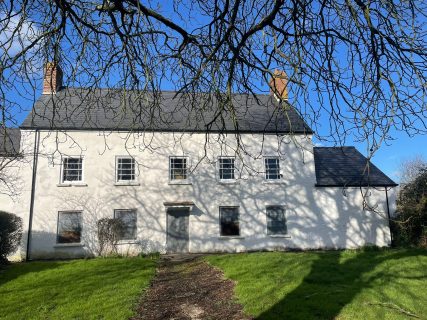
After growing up in Llandegveth and moving with his family to Whitson, William Watkins married Ann Baker at the age of 30. Their wedding took place on 25 April 1854 at the Parish Church of St Brides Netherwent. Ann was the daughter of William Baker and Ann Leonard, members of a well-known and prosperous farming family in St Brides Netherwent. Following their marriage, William and Ann settled at Pye Corner Farm in Nash, where William farmed the 111-acre property. Census records show that they remained at Pye Corner for forty years, demonstrating both stability and commitment to the land. In 1996, the farmhouse was designated Grade II listed status, recognised as a building typical of the traditional farmhouses of the Gwent Levels.
The family line of Ann Baker proved to be one of the most fascinating branches we researched. Tracing her ancestry led us to a Jewish émigré who left Germany for Britain to escape persecution. Samuel Levi was born in Frankfurt to parents Alexander and Erol Levi. He travelled to England with his brother Moses, and together they began establishing themselves, initially acquiring property in Lambeth, London. Recognising growing commercial opportunities in Wales, the brothers first settled in Swansea before later moving to the thriving port town of Haverfordwest in Pembrokeshire.
Samuel went on to make a significant impact in Wales. After adopting the surname Phillips, he became a successful jeweller and went on to found the Haverfordwest Bank. Over his lifetime he accumulated considerable wealth and property. Samuel married twice and had nine children. Among them was Catherine Levi, who married Samuel Baker; their daughter, Ann Baker, became our 2nd great-grandmother, linking this remarkable lineage to the Watkins family line.
William Watkins made a considerable success of Pye Corner Farm. He won awards for his cattle, and the farm’s beef, pork, and dairy produce were sold far and wide, earning him a strong reputation in the local agricultural community. Beyond farming, William became an influential figure in Nash. He stood unopposed as a local councillor and also served as a parish overseer – a role that involved organising the collection of local taxes and ensuring that parish rules and regulations were properly enforced.
William and Ann had nine children, all of whom were baptised at Nash Baptist Chapel. Their first child, William Henry, was born in 1855, followed by Eliza in 1857, Matilda in 1859, Herbert in 1861, Frederick in 1863, Selina in 1865, Rosa – our great-grandmother – in 1867, George in 1869, and finally Myra in 1873. The children received a good education in Nash and were raised in a household where fun and recreation were actively encouraged. As we began to explore the lives of the brothers and sisters of our great-grandmother, we uncovered a number of fascinating stories that added colour and character to the family history.
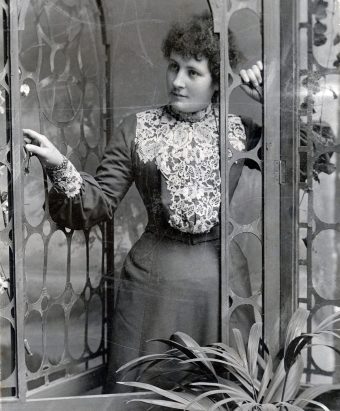
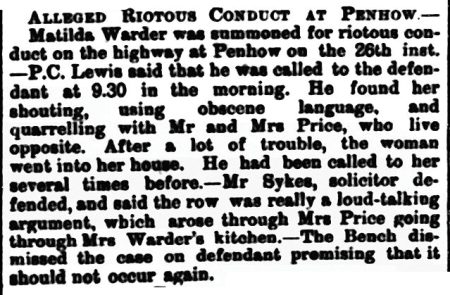
Among the children were Herbert and Frederick, both of whom emigrated to Australia in search of opportunity and adventure. Herbert eventually worked in farming, while Frederick tried his luck during the gold rush, even going so far as to form his own mining company – a bold and ambitious venture that speaks to his entrepreneurial spirit. Meanwhile, the youngest brother, George, followed in his father’s footsteps and pursued a life in farming. He went on to run Draenllwyn Farm in Christchurch, where he earned an excellent reputation, continuing the family’s strong agricultural tradition.
Their sister Matilda Watkins also led an eventful life. At just 18 years of age, she left home to marry Simeon Warder, who was 41 at the time. Following her marriage, Matilda moved to Penhow, where she worked alongside her husband at the village Post Office and General Store. However, her time there was unexpectedly interrupted by legal troubles. After being convicted of riotous behaviour, she was ordered by the court to return to her mother’s home in Nash.
In 1894, our great-grandmother Rosa Watkins married James Skinner of Kemeys Inferior and moved to Abernant Farm, beginning the next chapter in the Watkins family story. She was later joined by her younger sister, Myra, who lived at Abernant for the rest of her life. Myra also remained close to her brother George, living near him at Draenllwyn Farm in Christchurch with his family, maintaining the strong sibling bonds that characterised the family. James and Rosa had seven children of their own: Wallace, born in 1895; Ralph in 1896; Jessie in 1898; Donald – our grandfather – in 1899; Reginald in 1901; Raymond in 1903; and Margaret in 1909.
Through inheritances received from her father and later from her siblings William and Myra, Rosa and James were able to invest in additional property, acquiring land in Goldcliff as well as a farm in Newchurch East. These investments further strengthened the family’s agricultural standing and financial security. James died in 1927, leaving Rosa a substantial estate. A few years later, she left Abernant and went to live with her son Wallace at Hendrew Farm. Even in later life she remained deeply involved in family affairs and also worked as a governess at a local school. Rosa died in 1941 and was buried with James at All Saints’ Church. When the church was later demolished, both Rosa and James were reinterred at Tredunnock.
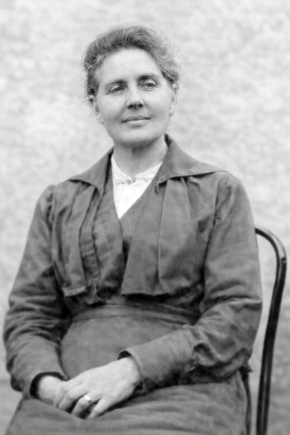
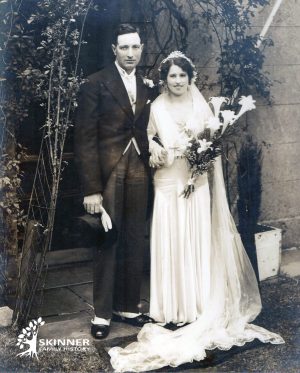
All of their children went on to achieve a great deal in their respective lives. Wallace, Ralph, and Reginald followed the long-standing family tradition of farming, each raising their own families in Monmouthshire and continuing the agricultural legacy established by earlier generations. Jessie pursued education, studying in Oxford before becoming a teacher. In later life, she retired to Jersey with her husband. Raymond established himself as a successful butcher in Newport, while the youngest sibling, Margaret, trained as a nurse. She later emigrated to South Africa, where she married and had a son, extending the family’s story overseas.
Our grandfather, Donald, remained at Abernant and became the third generation of the Skinner family to tenant the farm. On 4 June 1932, he married Catherine Phillips in Rogerstone. Catherine had grown up at Cwm Farm in Rogerstone with her parents and her older brother, Gus. Together, Donald and Catherine had two daughters: Mary, born in 1934, and Janet – our mother – born in 1937.
In 1941, Donald gave up the tenancy at Abernant and retired with his family to Langstone, where he took on a smallholding. Catherine continued to work and operated the local milk round for Unigate, becoming a familiar figure in the community through her daily deliveries. When their youngest daughter, Janet, married Bernard in 1964, Donald and Catherine purchased the house next door so the newlyweds could begin their married life close to the family home. Donald died in 1973, and Catherine in 1995; their ashes are buried at Langstone Church.
Their elder daughter, our Auntie Mary, married Raymond Adams in 1955, and together they had four children. Their first child, Susan, was born in 1962, followed by Paul in 1964, Kathryn in 1967, and Julian in 1969. The family eventually settled in Wolverhampton, where Ray worked for the Ministry of Agriculture, Fisheries and Food, while Mary built a career as a physiotherapist.
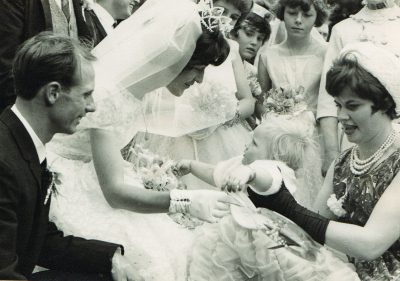
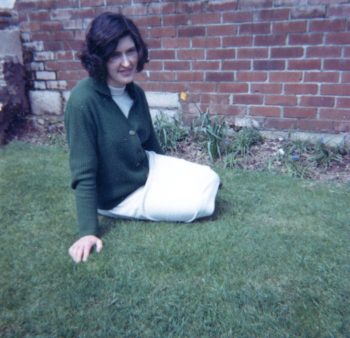
Our parents, Janet and Bernard, made their home at Langstone Cottage, where they raised the three of us – Cathy, Ann-Marie, and Rosie. Our father became a steelworker at Llanwern, dedicating his working life to the industry that shaped so much of the local community. He passed away in 1995 and was laid to rest following a packed service at Langstone Church, a testament to the esteem in which he was held. Our mother, whose health had been poor for some time, died in 2011 and was reunited with our father in Langstone.
Although the three of us no longer live in the area, we retain close links with Langstone and visit our parents’ grave regularly. Through this family history project, we were also given the opportunity to visit the graves of our aunts and uncles for the first time – a deeply meaningful experience that strengthened our connection to the generations who came before us and to the place that remains at the heart of our family story.